Growth doesn’t just “happen,” but it can definitely feel like a mystery when you’re busy doing all the right things and still not seeing results. So, what is a growth strategy, really? Well, it’s the difference between hoping your business improves and having a clear, intentional plan that actually moves the needle. Think of it as your roadmap for turning effort into real progress, instead of just staying busy.
In this guide, you’ll learn exactly what a growth strategy is, why it matters, and how to build one that drives meaningful, measurable results.
What Is a Growth Strategy?
A growth strategy is a deliberate plan that outlines how a business will increase revenue, market share, or customer base over a defined period. That's the growth strategy definition stripped to its core, and it's worth pausing on the word deliberate.
A business growth strategy isn't hoping things improve, posting more on social media, or setting a vague target to "do better this year." It's intentional, measurable, and tied to specific outcomes. Here's a simple analogy: a growth strategy is the GPS for your business journey. Without it, you might still move, but you won't know if you're heading in the right direction.
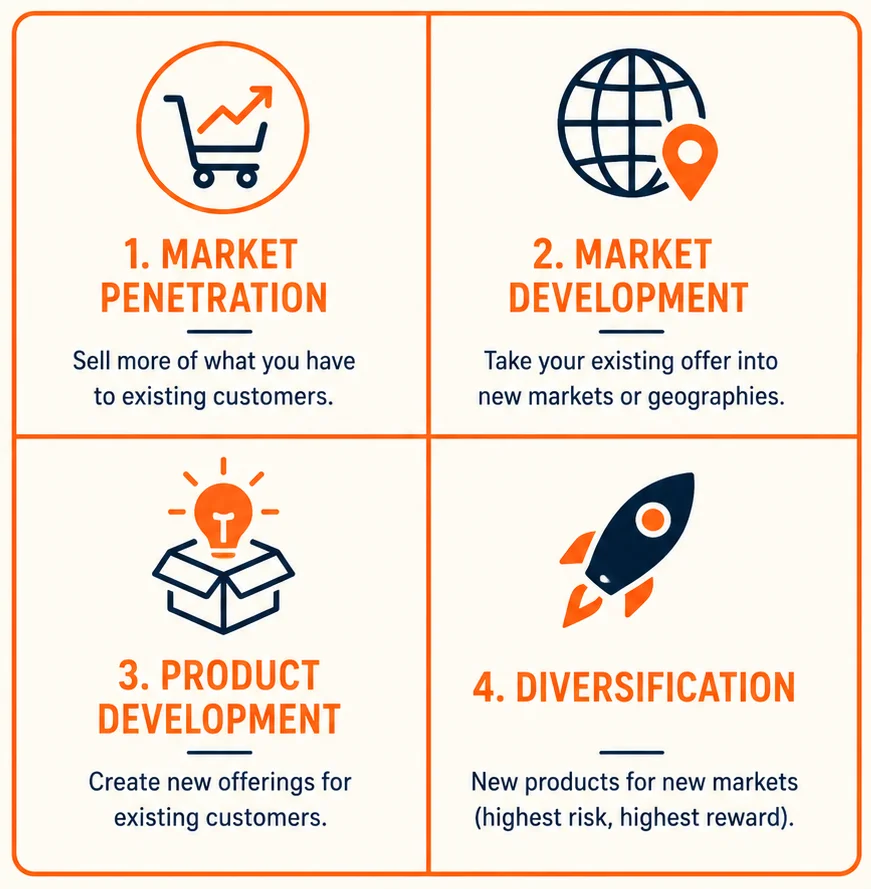
The classic framework for strategic growth is the Ansoff Matrix, a 2x2 grid mapping four growth strategy types:
Market Penetration: Sell more of what you have to existing customers
Market Development: Take your existing offer into new markets or geographies
Product Development: Create new offerings for existing customers
Diversification: New products for new markets (highest risk, highest reward)
A growth strategy is not a marketing plan, not a sales quota, and not a wish list. It's the strategic layer that sits above all of those, and it's what makes everything else coherent.
Why Strategic Growth Matters More Than Ever
Businesses today are operating in a landscape that’s more competitive and fast-moving than ever before. Customers are constantly comparing options, expectations are higher, and attention is harder to earn. Without a clear direction, it’s easy to fall into reactive habits: chasing trends, copying competitors, or investing in tactics that don’t actually drive meaningful results.
Strategic growth cuts through that noise by giving your business focus and intention. It ensures that every decision, from marketing to product optimization, works toward a defined outcome rather than pulling in different directions. When a clear strategy guides your growth, you’re not just keeping up with the market; you’re building something that stands out and scales with purpose.
The Mindset Behind Every Growth Strategy That Actually Works
Behind every strategy that actually works is a shift from a survival mindset to a growth mindset.
A survival mindset keeps you focused on short-term wins, quick fixes, and playing it safe just to stay afloat. It often leads to reactive decisions that might lead you to say yes to the wrong opportunities. In contrast, a growth mindset is built on long-term thinking, intentional risks, and a willingness to invest in what truly moves the needle. It’s about building something sustainable, not just getting through the next month.
When you operate with a growth mindset, you start to see challenges as signals, not setbacks. You’re more open to testing, learning, and refining your strategy based on real feedback instead of fear. This shift creates confidence in your decisions and consistency in your actions, both of which are essential for meaningful progress.
At the end of the day, your strategy can only take you as far as your mindset allows; so upgrading how you think is just as important as what you plan.
Key Components of a Successful Growth Strategy
A great growth strategy isn’t just a big idea; it’s built on a few key pieces that keep everything grounded and moving in the right direction. When these elements work together, your efforts feel less scattered and a lot more intentional, turning momentum into real, trackable progress.
Clear Growth Objectives
If you don’t know where you’re going, it’s pretty hard to get there. Clear growth objectives take you from vague goals like “we should grow” to specific targets you can actually chase. Whether it’s hitting a revenue number or boosting customer retention, clarity creates focus and accountability. Once your goals are locked in, every decision starts to feel a lot more purposeful.
Defined Target Market

Trying to speak to everyone usually means no one is really listening. A defined target market helps you zero in on the people who actually care about what you offer. This makes your messaging sharper, your marketing more efficient, and your brand way more relatable. When you truly understand your audience, connecting with them becomes a whole lot easier.
Strong Value Proposition
Your value proposition is your “why you” moment. It’s what makes someone stop, pay attention, and choose you instead of scrolling past or going with a competitor. A strong one clearly explains the benefits, not just the features, in a way that feels obvious and compelling. When you get this right, trust builds faster, and buying decisions feel easier.
RELATED: What Makes a Brand Unique in Crowded Markets?
Competitive Positioning
Being in the market isn’t enough; you need to stand out in it. Competitive positioning is all about carving out a space that feels uniquely yours. It highlights what you do best and makes it clear why you’re different. When your positioning clicks, your brand becomes easier to remember and harder to replace.
Data-Driven Decisions
Guessing might get you started, but data is what keeps you growing. Tracking the right metrics shows you what’s working and what needs a tweak. It takes the emotion out of decision-making and replaces it with clarity and confidence. Over time, this creates a rhythm of learning, improving, and scaling smarter.
Scalable Systems
Growth is exciting until things start breaking behind the scenes. Scalable systems ensure your business can handle more customers, higher demand, and greater complexity without falling apart. They keep things running smoothly, reduce stress, and free you up to focus on bigger opportunities. When your systems can grow with you, everything feels a lot more manageable.
RELATED: How Digitizing Customer Experience Can Fuel Business Growth
How to Create an Effective Growth Strategy: A Practical Process
Building a growth strategy doesn’t require guesswork; it requires structure and honesty. It’s about understanding where you are, where you want to go, and what needs to happen in between. When approached step by step, the process becomes far more manageable and actually usable in real-world scenarios.
Step 1: Audit where you are. Review your current revenue, customer base, and competitive position honestly. You can't chart a route without knowing your starting point.
Step 2: Define where you want to go. Set specific growth targets with a defined timeframe. Name the number and the mechanism.
Step 3: Identify your best growth lever. Use the Ansoff Matrix as your decision tool. Which quadrant matches your resources, risk tolerance, and market position? This is also the moment to identify new revenue paths you haven't yet explored.
Step 4: Map resources and identify gaps. Compare what your chosen strategy requires against what you actually have. Be honest about gaps before they surprise you mid-execution.
Step 5: Build accountability checkpoints. Quarterly reviews, clear KPIs, and a named person responsible for tracking progress. Strategy without accountability is just documentation.
This process is designed to be genuinely usable. The goal is a living plan you return to, not a document that earns a spot in a folder and is never looked at again.
Unlock Strategic Growth Using Thrill ’Em + Thrive
The Thrill ’Em + Thrive approach takes everything you’ve just read and brings it to life through a human-first lens. Instead of relying solely on tactics or trends, it focuses on creating meaningful experiences that naturally drive loyalty, referrals, and long-term growth. When you align strategy with real human connection, growth stops feeling forced and starts feeling inevitable:
Human-Centered Strategy: Build your growth around real customer emotions, not assumptions. When people feel understood, they’re far more likely to engage, buy, and come back.
Experience-Driven Growth: Go beyond transactions and create moments your customers actually remember. These experiences turn satisfied buyers into loyal advocates.
Authentic Brand Positioning: Show up as your true self instead of blending in with competitors. Authenticity builds trust, and trust accelerates every stage of growth.
This approach blends strategy with creativity and empathy, helping you build a business that not only grows but also resonates.
Final Thoughts on the Growth Strategy Framework
A growth strategy isn’t just a business exercise; it’s the foundation for everything you build moving forward. When you combine clear goals, smart positioning, and a deep understanding of your customers, growth becomes intentional instead of accidental. And when you layer in the right mindset and systems, that growth becomes sustainable.
If you’re ready to stop guessing and start building a strategy that actually works, the Thrill ’Em + Thrive course will guide you step by step, giving you the clarity, confidence, and tools to grow your business the right way. Reach out today to connect with me directly and start turning your growth goals into a clear, actionable plan.