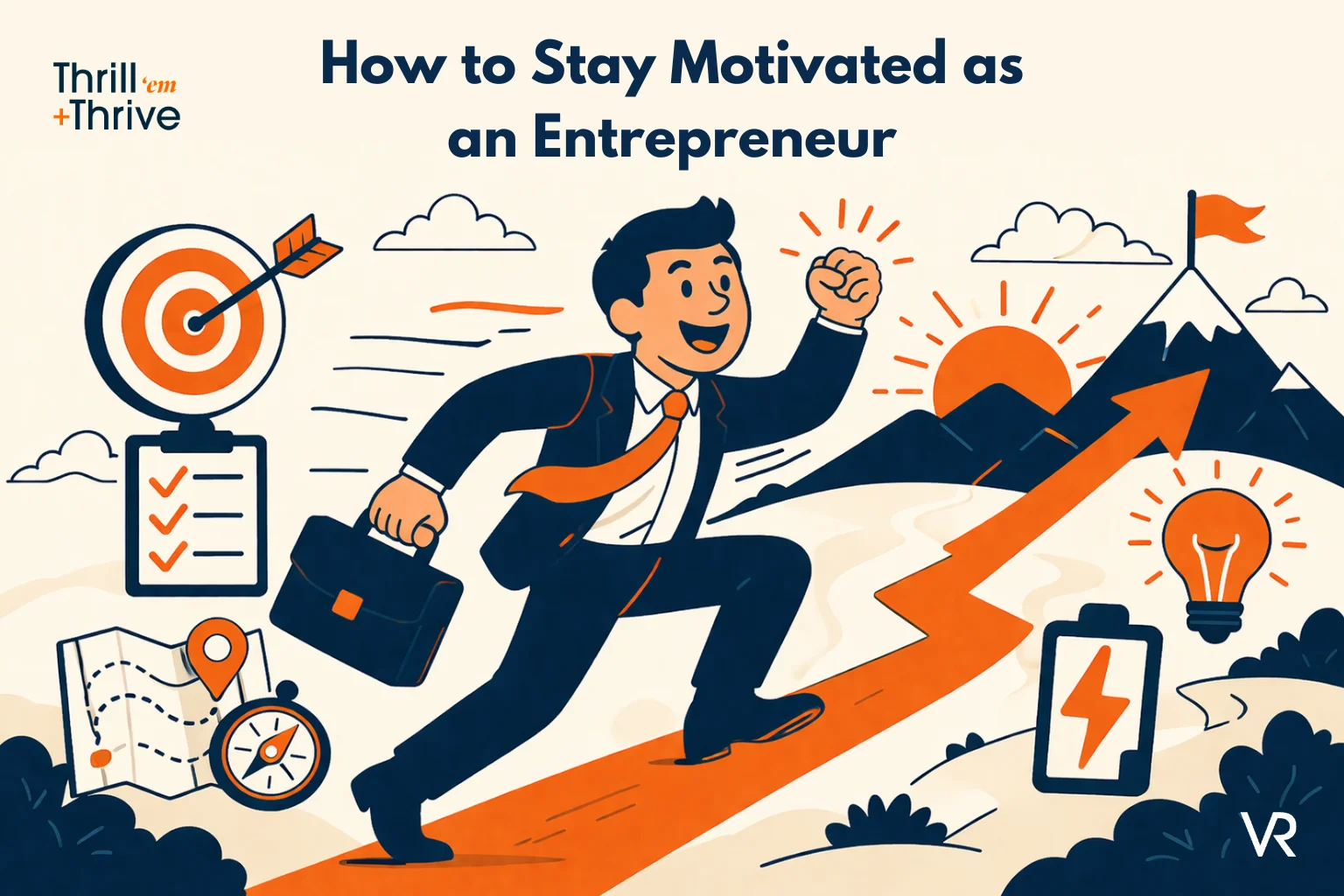
Ever notice how some days you feel unstoppable and other days even opening your laptop feels like a chore? Figuring out how to stay motivated as an entrepreneur isn’t about riding a constant wave of inspiration; it’s about learning how to keep going when that wave disappears.
The truth is, motivation comes and goes, especially in 2026, where everything moves faster, expectations are higher, and distractions are everywhere. This guide breaks down what actually drives entrepreneurs, what drains them, and how to build systems that keep you moving forward no matter what kind of day you’re having.
What Actually Motivates Entrepreneurs?
When people ask what motivates most entrepreneurs to go into business for themselves, the honest answer is: it depends, and it evolves. Research published via ScienceDirect identifies specific motivational factors influencing individuals' commitment to entrepreneurial activity, including perceived autonomy, sense of progress, and social belonging as key drivers.
Core motivators cluster around four themes:
Autonomy: Freedom to decide
Mastery: The drive to improve
Purpose: Building something meaningful
Profit: Financial validation
What motivates entrepreneurs to take risks isn't recklessness; it's the perception of opportunity. Founders take calculated risks because they believe the upside justifies the discomfort.
It also helps to distinguish push motivators from pull motivators. Push motivators drive you away from something (e.g., a draining job, financial instability). Pull motivators draw you toward something (e.g., a vision, a community to serve). Push gets you started. Pull keeps you going.
Profit plays a real role in this mix: it functions as market validation, confirming that what you're building creates genuine value. But it's a fragile foundation when revenue is inconsistent. Pair financial goals with purpose-based drivers so a slow month doesn't destabilize your reason for showing up.
Motivator Type | What It Looks Like | How Long It Lasts |
Push (Escape) | Leaving a bad job, financial pressure | Short to medium term |
Pull (Vision) | Passion for impact, desire to build | Long term |
Extrinsic (Profit) | Revenue growth, recognition | Fluctuates with results |
Intrinsic (Purpose) | Mission belief, craft love, identity | Most sustainable |
What Drains Your Motivation, and How to Spot It Early

Most content on staying motivated as an entrepreneur focuses entirely on how to build motivation. Almost no one asks what's destroying it, which is exactly why diagnosing your specific drain is the most underrated first step.
Here are the most common motivation killers, with an early warning sign for each:
Motivation Drain | Early Warning Sign | Quick Reset |
Social media comparison | Deflation after scrolling | Curate your feed aggressively |
Unclear goals | Busyness without direction | Rewrite your top 3 priorities |
Decision fatigue | Exhaustion over small choices | Batch decisions; use defaults |
Isolation | Dreading the start of work | Schedule one human interaction daily |
No visible progress | Effort without momentum | Track leading indicators, not outcomes |
Purpose misalignment | "Why am I doing this?" | Return to your original vision statement |
Identifying your specific drain is the first step to fixing it. Answer this honestly: "If my business made no money for six months, would I still be building it? Why?” Your answer reveals what's actually driving you, and what's quietly wearing you down.
RELATED: 5 Small Business Owner Burnout Signs & How to Avoid Them
The Mindset Shift That Separates Consistently Motivated Entrepreneurs From the Rest
Most motivation content stays tactical, such as journals, vision boards, and accountability partners. Those tools matter. But what truly drives entrepreneurs who sustain motivation across years is something deeper: identity.
Motivation that lasts is identity-based, not goal-based. When you see yourself as a builder, a problem-solver, a creator, showing up becomes self-reinforcing. You don't have to convince yourself to do what builders do. You just do it, because that's who you are.
This is exactly why building a business rooted in your Authentic Brand Concept matters: when your brand reflects your actual identity, every action you take in service of it reinforces who you are.
This is where behavior follows belief. If you believe you're the kind of entrepreneur who ships things even when they're imperfect, who reaches out even when it's uncomfortable, who keeps going when the numbers are discouraging, you will act accordingly.
Try this; complete the sentence: "I am an entrepreneur who ___." The blank should describe a process, not an outcome. "Ships a new offer every quarter" rather than "will be financially free."
Process identities are actionable today. Outcome identities are hostage to conditions outside your control.
What motivated you at month three won't always motivate you at year three, and that's not instability; it’s growth. Revisit who you need to become for the next chapter.
RELATED: Survival Mindset vs Growth Mindset: How to Make the Shift
How to Stay Motivated as an Entrepreneur: 6 Strategies That Actually Work

To maintain motivation as an entrepreneur, you don't need more willpower; you need better systems. Waiting to feel motivated before taking action is a trap. The goal is to keep your motivation high, not by managing your feelings, but by designing your environment so momentum becomes the default. When your work reflects your actual values and vision, sustaining that motivation becomes far more natural. Here are six strategies that work.
1. Reconnect With Your 'Why' Through a Personal Vision Statement
When motivation dips, the fastest reset is returning to purpose. Peter Gasca recommends a personal vision statement as the foundation of entrepreneurial motivation; a clear, written articulation of why you started and where you're going. Your 'why' doesn't change with a bad week.
Action step: Write a 2-3 sentence vision statement and place it somewhere you'll see it daily.
RELATED: The Importance of Finding Your Why Statement
2. Build Motivation Systems, Not Motivation Moods
Relying on inspiration to strike is like waiting for rain in a drought. Design systems that generate forward motion regardless of how you feel: a non-negotiable start time, a defined first task, a pre-work ritual. Systems create momentum, and momentum creates motivation; not the other way around.
Action step: Identify one daily habit you'll complete before any other work task, no matter what.
3. Break Large Goals Into Visible Milestones
Your brain's reward system needs regular feedback to stay engaged. When your only goal is "grow the business," there's no clear finish line, and motivation quietly starves. Break every big goal into weekly or monthly milestones and acknowledge each one when you hit it.
Action step: Take your biggest current goal and identify the next three micro-milestones on the path to it.
4. Control Your Information Environment
What you consume shapes your baseline energy. If your feed is full of founders who seem to be scaling effortlessly, your nervous system interprets that as evidence you're falling behind; even when you're not. Motivation for entrepreneurs is heavily influenced by the stories you tell yourself, and your inputs shape those stories.
Action step: Audit your top five social accounts and replace at least two with voices that energize rather than deflate.
5. Use Accountability Structures Deliberately
When internal motivation is temporarily offline, external accountability bridges the gap. Mastermind groups, peer check-ins, a business coach, or a public commitment create structure that pulls you forward when you'd otherwise stall. This isn't weakness; it's strategy.
Action step: Identify one person you can share a weekly goal with and schedule a 10-minute Friday check-in.
6. Celebrate Small Wins Consistently
Celebrating progress isn't indulgence; it's how your brain learns. Each time you recognize a win, your brain encodes the behavior as worth repeating. Skipping this because the win feels "too small" trains your brain that effort doesn't lead to reward.
Action step: End every workday by writing down one thing you moved forward, no matter how small.
Building a Daily Routine That Keeps Your Entrepreneurial Fire Burning
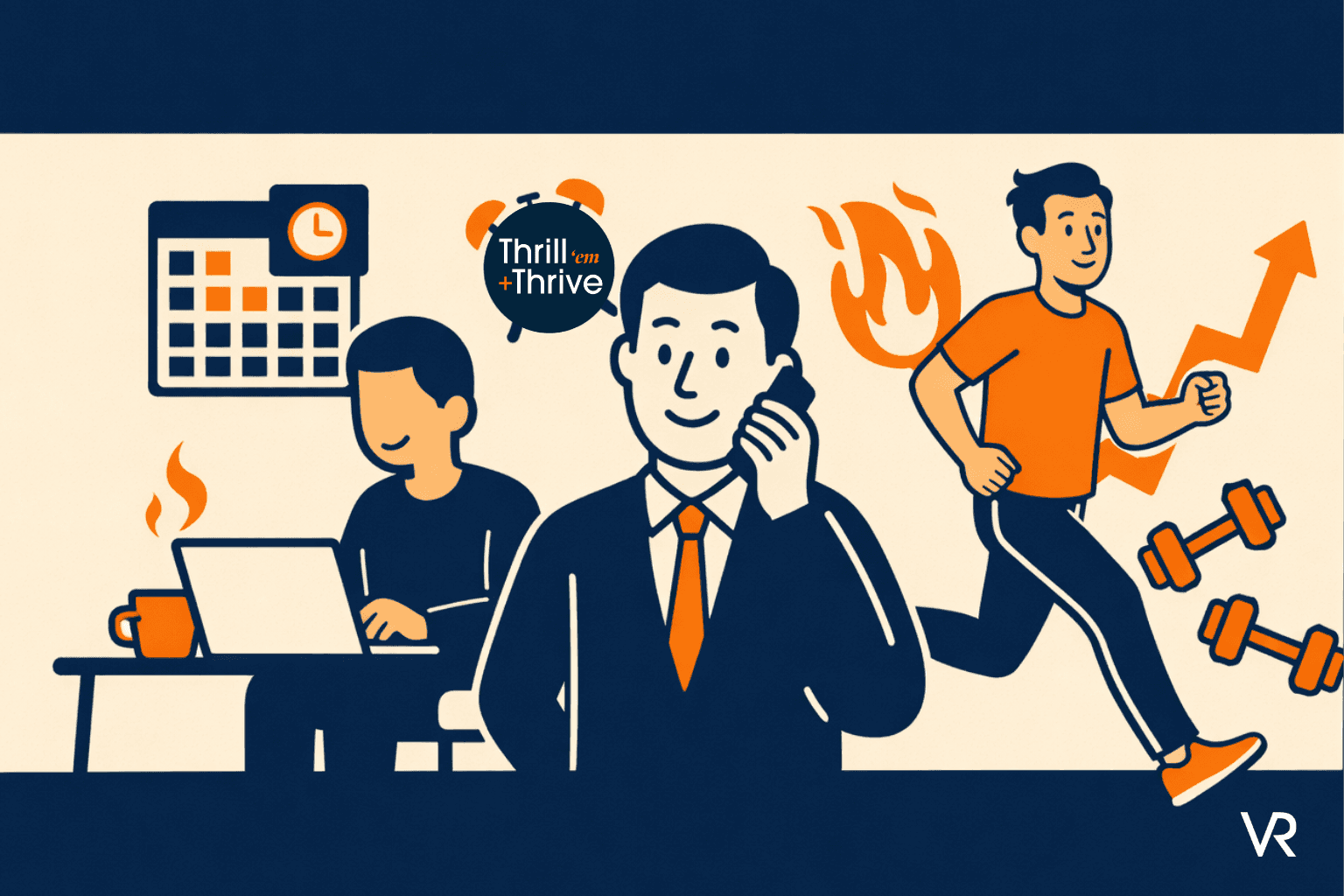
Sustaining motivation long-term isn't about staying fired up every moment — it's about creating reliable daily signals that orient you toward your work and purpose. Decision fatigue is real: the more choices you make before your most important work, the less mental energy you have left. Routine eliminates that friction. Structure your day around three intentional blocks:
Morning: Set Intention
Review your vision statement, identify your one most important task, and move your body. Research consistently points to movement as one of the most effective tools for sustaining energy and focus throughout the day. The principle here is simple: by removing the decision about whether to show up, you protect your energy for the work itself.
Midday: Check progress
A quick check-in against your daily priority keeps you honest and allows real-time course correction before the day slips away.
End of Day: Reflect and Reset
Note one win, one learning, and tomorrow's single most important task. This closes the mental loop and prevents the low-grade anxiety of unfinished thinking.
For those wondering how to maintain motivation when you don't want to work, a simple motivation journal helps: one sentence in the morning ("Today I will ___") and one at night ("Today I moved forward because ___"). Over time, this converts abstract motivation into a traceable daily identity.
Staying Motivated During Tough Seasons in Business
Staying motivated during tough seasons feels different from ordinary low-energy days. Cash flow crises, failed launches, team friction, market shifts, these aren't productivity problems; they're emotional events that deserve a different response than a new morning routine.
For those staying motivated as a small business owner through genuinely hard stretches, a three-phase framework helps:
Phase 1 - Triage: Determine whether you're facing a motivation problem or a strategy problem. If your tactics are working but you feel uninspired, that's motivation. If you're working hard and nothing is responding, that may require a pivot, not a pep talk.
Phase 2 - Reconnect: Return to minimum viable action. Not your full ambitious plan, just the smallest version of showing up that keeps the business moving. Rebuilding momentum from one complete task beats forcing productivity you don't have.
Phase 3 - Reach out: Keeping motivation high as a business owner through a rough patch almost always requires community. Talk to a mentor, join a peer group, or tell someone what you're navigating. Isolation amplifies difficulty; connection shrinks it.
One more thing worth naming: the thought "maybe I'm not cut out for this" surfaces hardest in tough seasons. Recognize it as a cognitive distortion, not a fact. Resilience isn't built despite hard seasons. It's built in them.
Learn How to Build and Maintain Momentum with Thrill ’Em + Thrive
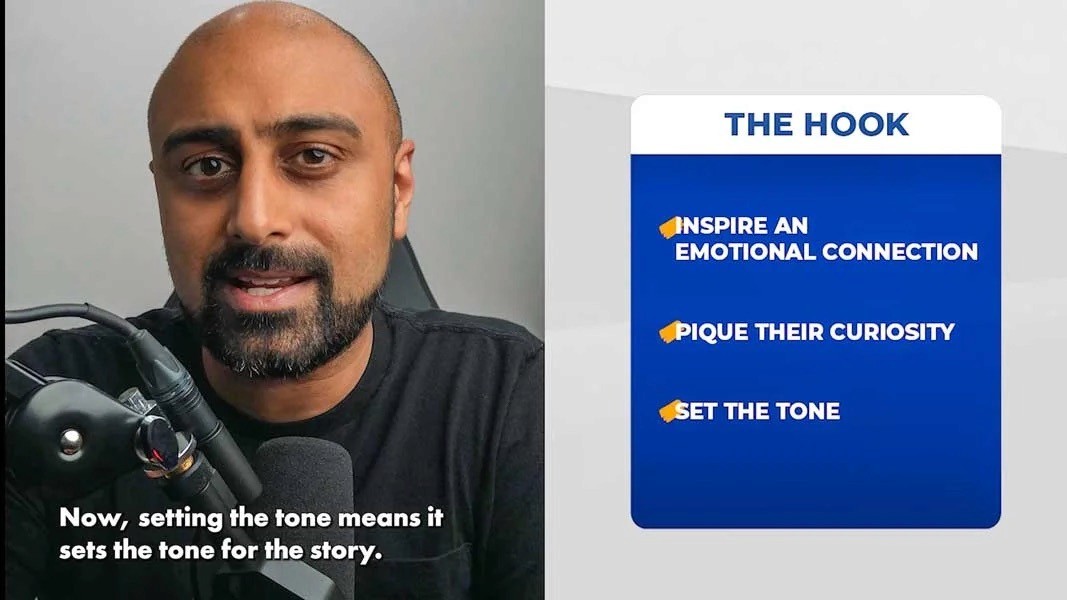
If you want motivation to feel natural rather than forced, you need a framework that connects your work to something human. That’s exactly what Thrill ’Em + Thrive is built for; it’s not just about strategy, it’s about motivating entrepreneurs by helping them reconnect with meaning, creativity, and real-world experiences.
Here’s what that looks like in action:
Human-First Strategy: You stop chasing random tactics and start building around real people. This makes your work feel more meaningful and easier to stick with.
Experience-Driven Growth: Instead of just “doing marketing,” you create moments that excite both you and your customers. That energy feeds your motivation daily.
Clarity Through Structure: You get a clear roadmap, so you’re not guessing your next move. Less confusion means more consistent action.
When your business feels aligned and engaging, motivation stops being something you chase and starts to show up naturally.
At the end of the day, staying motivated isn’t about hype; it’s about clarity, systems, and momentum. If you’re ready to build a business that actually excites you while growing it at the same time, check out Thrill ’Em + Thrive and get the support you need to level up.
Frequently Asked Questions
How do I stay motivated as an entrepreneur when I'm not seeing results?
Focus on controllable actions like calls made or content created, because consistent small wins build momentum and eventually lead to results, even if you can’t see them yet.
What motivates most entrepreneurs to go into business for themselves?
Most entrepreneurs are driven by a mix of autonomy, purpose, and financial freedom, often pushed by frustration and pulled by a vision they want to bring to life.
Is it normal to lose motivation as an entrepreneur?
Yes, motivation naturally fluctuates for everyone, and successful entrepreneurs stay consistent by relying on systems that help them quickly regain focus.
How does profit motivate entrepreneurs?
Profit validates that your business is creating real value, but it works best when paired with purpose so your motivation stays strong during slower periods.
Key Takeaways
Motivation comes from clarity, not constant excitement: when you know exactly what you’re working toward and why it matters, it’s much easier to show up consistently, even on low-energy days.
Small wins and daily systems build long-term momentum: breaking big goals into simple, repeatable actions creates progress you can actually see, which naturally keeps you moving forward.
What motivates entrepreneurs goes beyond money; it’s identity and purpose: profit matters, but lasting motivation comes from feeling connected to what you’re building and who you’re becoming in the process.
Tough seasons are part of the process, not a sign to quit: slow periods, failed ideas, and uncertainty are normal, and learning to navigate them builds resilience and long-term success.
The right framework makes staying motivated feel natural: when your strategy, routine, and mindset all align, motivation becomes a byproduct of your environment instead of something you constantly have to force
Feb 13, 2026

Business strategy doesn't have to be boring! Your business has the power to spread joy and change the world! Let's unleash your potential - we got this!